Montessori vs Reggio Emilia vs PAUD: Bali Preschool Guide 2026
Need personalized advice for your Bali journey? Ask our AI Bali Mom—expertly trained by parents with 10+ years on the island.
Start Chatting →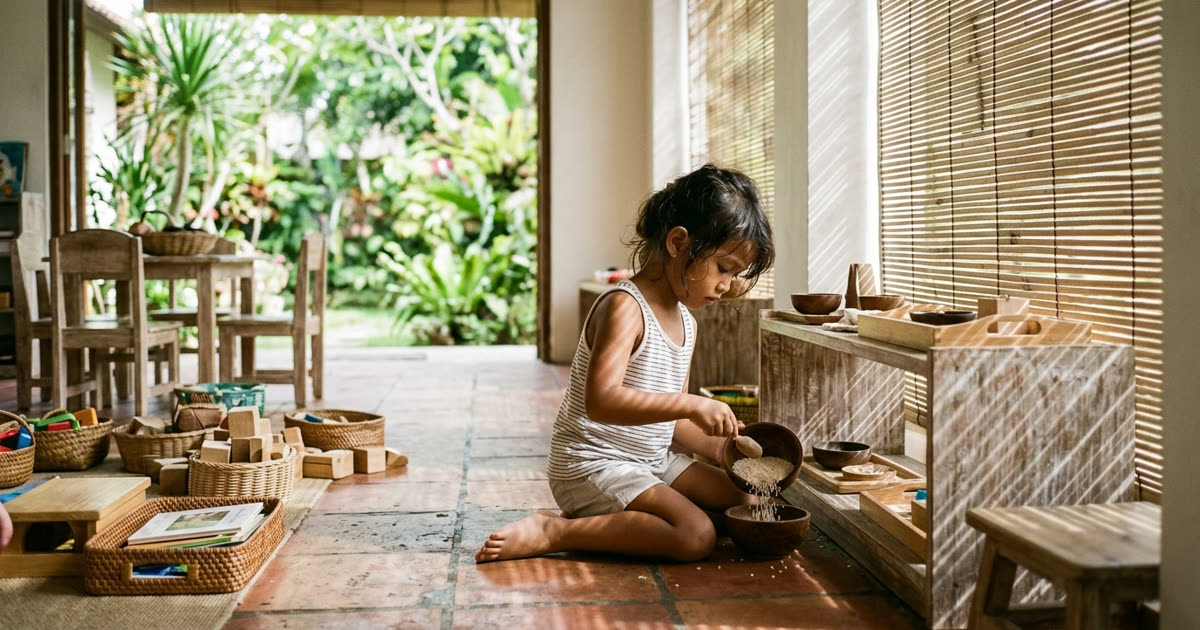
The Direct Answer
Montessori fits a child who thrives on quiet, self-directed order and likes working with their hands at their own pace. Reggio Emilia fits a curious, chatty kid who learns by building, arguing, and creating with others. A Bali PAUD fits families who want Bahasa Indonesia immersion, a genuine local community, and the lightest monthly fee. None of the three is objectively better — the pricier international option is worth the extra cost only if it actually matches your child's temperament, not because the sign out front looks fancier.
The Reality of Choosing a Preschool in Bali
Here's what trips up almost every new family: "Montessori" and "Reggio Emilia" are not protected words in Indonesia. Anyone can paint them on a gate. A school can run a traditional, teacher-led classroom and still call itself Montessori because it owns a shelf of wooden materials. Experienced Bali families will tell you the label gets you in the door — it doesn't tell you what actually happens once your kid is inside.
What "Montessori" Actually Means, In Practice
A genuine Montessori room is quiet, mixed-age (usually 3 to 6 in one class), and built around a defined set of self-correcting materials (pouring, sorting, letter tracing with sandpaper letters) that kids choose from and work through independently. Experienced Bali families recommend watching for long uninterrupted work blocks (60 to 90 minutes) rather than a schedule chopped into 15-minute activities — that single detail separates the real thing from the label.
What "Reggio Emilia" Actually Means, In Practice
Reggio classrooms follow the children's own questions instead of a fixed sequence. A term might spend three weeks on "water" because that's what the kids got obsessed with. You'll see documentation everywhere: photos, transcribed quotes from the kids, work displayed at their eye level. It leans on art, loose materials like blocks and fabric, and group projects. It asks more of the teachers — skilled improvisation, not a script — so according to local expat communities, it's worth asking directly how long the lead teachers have been there.
What a Bali PAUD Actually Is
PAUD (Pendidikan Anak Usia Dini) is Indonesia's own early-childhood framework, and a real one is registered with the local education office. Confirm that: it matters if your child later transitions into an Indonesian school. Classic PAUD is more structured and group-paced than Montessori or Reggio, taught in Bahasa Indonesia (sometimes bilingual), and rooted in the neighbourhood, not an expat bubble. A lot of the best ones in family-heavy areas like Ubud and Canggu have quietly absorbed play-based and Montessori-style materials without renaming themselves. Experienced Bali families often say: don't dismiss a PAUD just because the branding is plain.
Vetted Recommendations
Kupukupu Kingdom (Ubud)
A nature- and farm-based early years program in Ubud built around outdoor, hands-on learning rather than a worksheet or a screen. If your child is happiest barefoot, digging in the dirt, or around animals, this is worth a visit. Worth noting: Ubud sits roughly 45 to 60 minutes by car from Canggu or Seminyak depending on traffic, so factor the commute in if you live on the south coast. Ask directly about their daily balance of structured versus free outdoor time so you know what a real day looks like before you commit.
Green School Bali
The best-known international campus on the island: bamboo architecture, a deep sustainability focus, and an early-years approach built around experiential, nature-immersed learning rather than desks. It sits at the premium end of the fee scale and has a large, well-established expat and local community around it. According to local expat communities, it's a strong fit for families planning to stay in Bali long-term and wanting one continuous school through the older grades. Visit before assuming it's the answer, since its style is distinct and won't suit every child.
Kiddy School Bali
A more mainstream, community-oriented preschool, structured around bilingual (English/Bahasa) instruction with a blend of guided activities and play. It sits closer to the mid-range fee band than the flagship international campuses. Experienced Bali families describe it as a sensible visit for those who want structure and a warm, local feel without the premium price tag. Ask to see a live class in session — website photos rarely tell you what the noise level and teacher-to-child ratio actually feel like.
Pro-Tips: What the Locals Know
- Do a trial day, not just a tour. Almost every school here will let you sit in for a morning. Tours show you the building; trial days show you the teachers.
- Ask about teacher retention, not just credentials. A school that loses its lead teachers every six months will feel different from the brochure, no matter the curriculum name.
- Check the accreditation, quietly. If you might move your child into an Indonesian school later, or need paperwork for a visa sponsor, ask whether the school is registered PAUD. Not every "international" preschool is.
- Factor in the wet season. Covered walkways, how naps are handled without harsh AC, and mosquito management matter more day-to-day than curriculum philosophy.
- Price it in bands, not numbers. Fees shift year to year and rupiah figures go stale fast, so treat any specific number you find online as outdated. Think budget, mid-range, or premium, and ask the school directly for current figures.
- Talk to parents already there, not just the admissions team. The school-gate WhatsApp group will tell you more in ten minutes than any prospectus.
A Conscious Note
However you choose, remember that Bali's PAUD system is the backbone of local early education, staffed overwhelmingly by Balinese teachers who trained in it long before international families arrived. Treat it with the same respect you'd give any accredited school, not as a fallback. Wherever you land, pay fairly, on time, and without haggling down local staff. Look for real ways to give back to the school community, not just extract a good rate from it. Choose what suits your kid, but choose it in a way your family can stand behind as good neighbours, too.
Quick-Reference FAQ
Is Montessori better than Reggio Emilia for my toddler? Neither Montessori nor Reggio Emilia is objectively better for a toddler — the right choice depends entirely on your child's temperament. A kid who likes calm, independent, repeatable tasks often does well in Montessori, while a kid who's constantly asking "why" and wants to build things with friends often thrives in Reggio Emilia. Experienced Bali families recommend visiting both and watching which room your child relaxes into before deciding.
Can my child move between a PAUD and an international preschool later? Yes — plenty of Bali families move their child between a PAUD and an international preschool, and the transition is generally manageable. The main adjustment is language: a child coming from an English-only classroom into a Bahasa-heavy PAUD, or the reverse, may need a few months to settle in. Ask any school you're considering how they support new mid-year arrivals so you know what to expect.
Do I need a specific visa for my child to attend preschool in Bali? Visa requirements for enrolling a child in a Bali preschool depend on your family's visa type and the individual school's enrollment policy, and as of 2026 the rules shift often enough that forum advice can go stale within months. As a general guide, a social-cultural (B211A) visa typically covers an initial 60-day stay, while families settling in longer-term usually sponsor a KITAS (limited stay permit), commonly issued for six or twelve months. Ask the school directly what they require for enrollment, and verify anything visa-related with an official immigration source or a licensed agent before you commit.
Get the weekly Bali family digest
Events, new guides, one seasonal tip. No spam.
One email a week. Unsubscribe anytime.
Related Articles
Trusted Bali family partners
Balu Kids
UbudBalu Kids is a Montessori children's center near Ubud, in Kemenuh, Sukawati (Gianyar), about 30 minutes by car from central Ubud. It offe…
View partner →Biosphere School
JimbaranBiosphere School is a nature-integrated international school in Jimbaran, Bali, offering an inquiry-based curriculum designed to nurture…
View partner →Bali Sunny Kids
UbudBali Sunny Kids is a play-based preschool in Ubud for little ones aged 18 months to 6 years, welcoming both local and international famil…
View partner →