How Bali Homeschool Families Build Routine
Need personalized advice for your Bali journey? Ask our AI Bali Mom—expertly trained by parents with 10+ years on the island.
Start Chatting →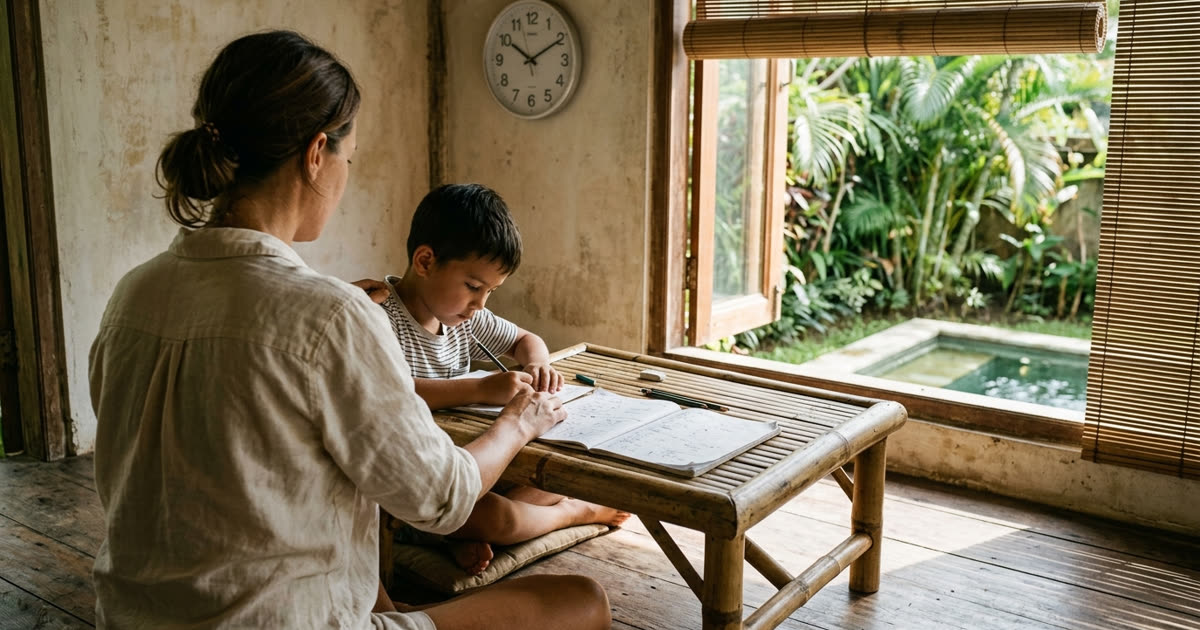
How Bali Homeschool Families Build Routine
Homeschooling families in Bali build a routine that survives remote work by running two small, separate schedules instead of one big one: a protected work block and a short, rhythmic school block, anchored by the same three or four times of day, every day. Routine here isn't about filling hours. It's about making the transitions — laptop closed, workbook open — feel automatic instead of negotiated every single morning.
The reality of homeschooling in Bali with a remote job
Most families who land in Bali planning to homeschool and work from home get the first month wrong in the same way: they try to build the routine around Bali. Around the beach at sunrise, the co-working membership, the idea that island life makes structure easier. It doesn't. A tropical climate and a flexible schedule remove more guardrails than they add, and kids notice within days when "school time" has no fixed shape.
What actually works looks almost boring. Treat homeschooling like a job with fixed hours, not a lifestyle that happens whenever the mood strikes. Pick a start time and protect it the way you'd protect a client call. Heat, humidity, and the 9 a.m. energy crash that hits a lot of kids here mean the best focus window is often earlier than it was back home. Many families shift core lessons to before 11 a.m. and use the afternoon for anything physical or outdoor.
The other thing newcomers underestimate: internet and power aren't always predictable, even in family-dense areas like Canggu or Ubud. A routine that depends on video calls or streamed curriculum at a specific minute will eventually break. The families who stay calm build in slack, a buffer block or a backup offline activity, rather than treating one dropped connection as a crisis.

What to look for when building your routine
There's no single right schedule. But the families who settle in fastest tend to choose deliberately across a few core trade-offs, rather than drifting into whatever happens.
Fixed blocks vs. flexible flow
Some families run a tight timetable: math at 8, reading at 9, break at 10. Others run loose blocks ("morning is school, afternoon is life") and let the order shift day to day. Neither is better. Younger kids and kids who are new to homeschooling generally do better with fixed blocks; they haven't yet built the internal sense of "what comes next." Older kids and confident independent workers often thrive with more flexibility, as long as the start and end of school time stay consistent.
Co-working with kids present vs. separate hours
Some parents work from the same room as their children, weaving in short check-ins between calls. Others split the day so one parent (or a rotating shift) is fully off-duty from work during school hours. If your job has hard meeting times, separate hours protect both your focus and your kid's: trying to homeschool between Zoom calls is the fastest route to a frayed afternoon.
Solo homeschooling vs. community-based learning
A growing number of families here don't homeschool entirely alone. Homeschool co-ops, forest-school-style outdoor programs, and shared-lesson pods exist across family hubs like Canggu and Ubud, and joining one (even for just a morning or two a week) takes pressure off any single parent to be the whole curriculum. Ask directly about group size and age mix, then confirm the actual session format with the organizer, since last term's format may not hold.
Screen-based vs. hands-on curriculum
Bali's climate and light make outdoor, hands-on learning easy to lean into: nature study, market maths, language practice with people you meet. Families who build at least one hands-on block into the day, even a short one, see fewer battles than families running a fully screen-based curriculum in a place this alive outside the window.
Practical tips for a routine that actually survives
These are the habits that separate a routine that lasts from one that quietly falls apart by week three:
- Anchor the day with the same two fixed points (wake time and school start) rather than trying to time-block every hour. Fewer fixed points are easier to protect than a full schedule.
- Front-load focus-heavy subjects before the midday heat. Save read-alouds and physical activity for the afternoon slump.
- Give work calls a visible signal (headphones on, a sign on the door) so kids learn to read it faster than any verbal reminder.
- Build in one buffer block a day for the internet outage or the day nobody wants to do fractions. A routine with zero slack breaks on the first bad day.
- Batch your own work into recognizable chunks (deep work and meetings) instead of drip-feeding it across the day. It's easier to homeschool around three blocks than around twelve interruptions.
- Revisit the schedule every school term, not every week. Kids' energy and attention shift as they grow; a routine that worked in month one often needs a real adjustment by month four, not just a tweak.
- Get outside daily, on purpose. It's the easiest lever Bali gives you, and it resets focus better than another worksheet does.
A conscious note
Building a homeschool life here means sharing space with a community that was doing just fine before international families arrived. Where you can, choose local suppliers for school materials and snacks over imported alternatives, and treat any co-op or outdoor program as a guest would: ask what's appropriate rather than assume. If your routine includes outings into village or ceremony life, build in time to slow down and let your kids learn the etiquette rather than rushing through it. Confidence in a routine doesn't excuse rushing past the community that's hosting you.
Quick-reference FAQ
Do I need a fixed daily schedule, or can we stay flexible? Bali homeschool families can succeed with either approach. Younger kids and families new to homeschooling usually do better with fixed start and end times; confident older kids can often handle a looser flow, as long as the boundaries around work hours stay clear.
What's the best time of day to do focused lessons in Bali? Mornings work best for focused lessons in Bali, before the midday heat and energy dip set in. Save physical or outdoor learning for the afternoon.
What if my child seems to be really struggling, not just having an off week? Persistent focus or mood struggles are worth more than a schedule tweak. If the problem is ongoing rather than occasional, it's a good moment to talk to a paediatrician or an educational specialist. Asking early is a normal, sensible step, not an overreaction.
Get the weekly Bali family digest
Events, new guides, one seasonal tip. No spam.
One email a week. Unsubscribe anytime.
Related Articles
Trusted Bali family partners
Balu Kids
UbudBalu Kids is a Montessori children's center near Ubud, in Kemenuh, Sukawati (Gianyar), about 30 minutes by car from central Ubud. It offe…
View partner →Malinki School
KerobokanMalinki School is a nurturing international school in Kerobokan, Bali, offering a creative, child-centred curriculum that blends global l…
View partner →Matahari Canggu
CangguMatahari Canggu is a warm, play-based early learning centre for babies, toddlers and young children from 6 months to 6 years. Children le…
View partner →