Bali Temple Rules for Families 2026: Kids, Dress & Don'ts
Need personalized advice for your Bali journey? Ask our AI Bali Mom—expertly trained by parents with 10+ years on the island.
Start Chatting →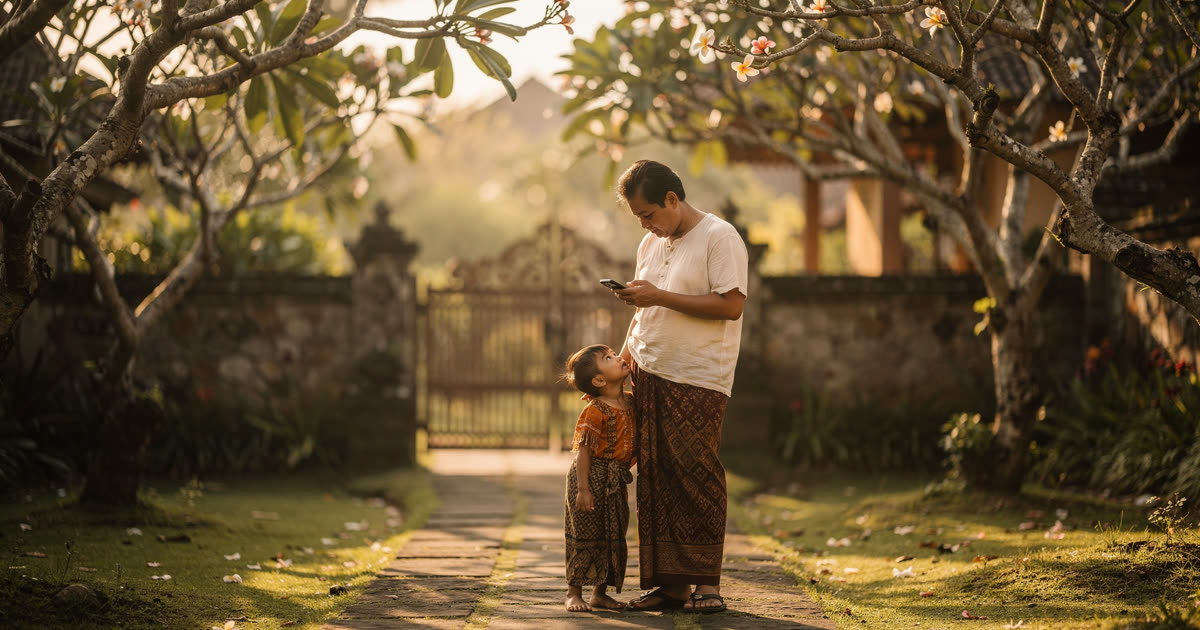
Children aged 5 and older must wear a knee-covering sarong and sash to enter Balinese temples; some stricter temples require it for younger children too. Menstruating women, sick children, and recently bereaved family members must stay out of inner sanctums (jeroan). Active Hindu ceremonies are closed to non-Hindus — foreigners may observe from outer courtyards only. If your child accidentally disturbs a sacred offering, apologize quietly to a nearby priest or temple guardian, say maaf (sorry), and follow their guidance. Genuine remorse is understood across every language barrier in Bali.
The Reality of Temple Culture in Bali
Most families arrive thinking temples are tourist attractions with a dress code. They're not. They're active, living houses of worship where ceremonies happen daily, sometimes multiple times a day. Bali has approximately 20,000 Hindu temples — roughly one for every 200 residents (Bali Provincial Government cultural records) — which is why experienced Bali families recommend treating every temple visit as an encounter with an active place of worship, not a heritage site. The "rules" aren't arbitrary. They're spiritual logic that's been consistent for centuries.
What newcomers consistently get wrong:
- They think the sarong rental at the gate is the dress code. It's the minimum, not the full picture.
- They assume that because the outer courtyard is accessible, everything inside is too.
- They photograph everything. Including things that should never be photographed.
- They bring kids during their own period without knowing that, in traditional Balinese Hindu belief, menstruation means a woman is considered sebel (spiritually impure) and should not enter inner temple spaces.
The Balinese are patient, gracious people. But patience is not the same as permission. Here's how to do this right with kids in tow.
Vetted Recommendations for Family Temple Visits

Pura Tirta Empul (Tampaksiring)
This is the one. The holy spring temple north of Ubud is where most expat families, whether based in Canggu, Seminyak, or Sanur, have their first real encounter with Balinese temple culture, and where most mistakes happen too.
The purification pools (petirtaan) are not a spa feature. They're a functioning sacred bathing site where Balinese Hindus come to cleanse spiritually. Visitors are permitted to wade in, but only in the designated areas marked for tourists, wearing a sarong that gets fully wet. You do not enter the fountain spouts reserved for Hindu worshippers conducting melukat (spiritual cleansing rituals).
Specific rules for families here:
- Children old enough to walk independently should wear a sarong and sash. No exceptions at the inner gate.
- Do not let toddlers run or splash near active worshippers.
- The two leftmost fountain spouts are reserved for Hindu ceremony. Off limits to visitors.
- Photography of people mid-ritual requires explicit consent. In practice, don't.
- Menstruating women and anyone who is ill or recently bereaved should wait in the outer courtyard.
The temple itself dates to the 10th century. That context alone should reframe how you talk about it with your kids before you arrive.
Threads of Life (Ubud)
Not a temple, and that's exactly why it belongs on this list.
Threads of Life is a textile gallery and fair-trade organization in central Ubud that runs family-oriented workshops designed to give context to Balinese offerings, ceremony, and textile culture without requiring access to sacred space. Their Understanding Offerings workshops are genuinely excellent. Your kids make their own canang sari (daily flower offering) with proper guidance on meaning, not just aesthetics.
According to long-term expat families in Ubud, starting at Threads of Life before visiting major temples significantly reduces the awkward boundary-crossing moments that happen when kids have no cultural frame of reference. The staff are knowledgeable, the atmosphere is calm, and you're directly supporting local artisans and cultural preservation.
Ubud Palace (Puri Saren Agung)
The royal palace at the center of Ubud is one of the few places where families can watch legitimate Kecak, Legong, or Barong dance performances in a setting that bridges ceremonial tradition and cultural access, without crossing into sacred-only space.
Evening performances here (typically starting at 7:30pm) happen in the open-air courtyards, produced in collaboration with the royal family and local dance troupes. These are not watered-down tourist shows. The performers are trained in the same traditions used in actual ceremony. This is the public-facing expression of that art.
Kids do well here. The dancing is visually arresting, the music is visceral, and it's usually done by 9pm. Arrive 20 minutes early for good seats. The palace setting, torch-lit and surrounded by ancient carved stone, does a lot of the explaining for you.
Pro-Tips: What the Locals Know
- Sarongs need to cover the knees. A wrap that only hits mid-thigh won't get you through an inner gate, regardless of what the rental stall hands you.
- Footwear comes off at the inner courtyard entrance, not at the outer gate. Watch where locals remove their sandals.
- Yellow, white, or black-and-white poleng fabric on a gate or statue means an active offering or ceremony is in progress. Slow down, be quiet, and follow the lead of the people around you.
- Don't point your feet toward altars or offerings. Sit cross-legged or kneel if you're resting near sacred objects.
- Kids who are visibly sick should stay home. This isn't just courtesy. It's taken seriously as a form of respect for the spiritual space.
- Temple guardians (pecalang) are not security staff in a Western sense. They're community members with actual spiritual authority. If one approaches you, stop and listen.
- Asking boleh foto? ("may I photograph?") goes a long way. Most Balinese will appreciate that you asked.
- Bring small bills for the donation box. IDR 20,000–50,000 per adult is appropriate. It goes to temple maintenance.
A Conscious Note
Bali's temples are not struggling for visitors. What they need is better visitors. Every time a family takes genuine care, it adds to something: teach your kids to bow when passing a priest, wait outside a ceremony rather than pushing through, buy a proper sarong instead of the cheapest rental. The Balinese notice. They remember. Experienced Bali families who consistently show respect tend to get quietly invited into spaces that casual tourists never see. Spend time at places like Threads of Life that directly fund cultural preservation. Tip the local guides who explain why, not just what. Tread lightly, and you'll find Bali opens up in ways that no itinerary can manufacture.
Quick-Reference FAQ
Do children need to wear a sarong to enter Balinese temples? Yes — children aged 5 and older are generally required to wear a knee-covering sarong and sash to enter Balinese temples, and some stricter temples will ask for it on younger children too. According to local expat communities in Ubud and Canggu, the sarong must cover the knees; a wrap that only hits mid-thigh will be turned away at inner gates. Most temple entrances rent sarongs for IDR 10,000–20,000 if you forget, but bringing your own is a sign of preparation the Balinese genuinely appreciate.
Can foreigners attend Balinese Hindu ceremonies? Foreigners may observe from outer courtyards and public temple grounds at almost any time, but inner jeroan areas during active Hindu ceremonies are for worshippers only — this boundary is not negotiable. Experienced Bali families recommend stopping at the outer gate when a ceremony is in progress, watching respectfully from a distance, and asking a temple guardian (pecalang) directly if you're unsure where the boundary falls. The royal dance performances at Ubud Palace offer a culturally legitimate alternative that gives families real ceremonial context without crossing into restricted sacred space.
What should I do if my child accidentally disrespects something at a temple? Stay calm and do not make a scene. If your child knocks over an offering, replace it as best you can and apologize quietly to whoever is nearby. If a temple guardian or priest approaches, bow your head slightly, say maaf (the Indonesian/Balinese word for sorry), and follow their guidance without argument. According to families who have navigated these moments, genuine remorse combined with calm, respectful body language resolves almost every situation — the Balinese distinguish clearly between honest mistakes made by visitors who are trying, and willful disregard from people who never cared at all.
Get the weekly Bali family digest
Events, new guides, one seasonal tip. No spam.
One email a week. Unsubscribe anytime.
Related Articles
Trusted Bali family partners
Mogi Artperience
SanurMogi Artperience is a warm, hands-on art studio in Sanur, Bali, where children and families explore painting, drawing, and crafts guided…
View partner →Backus Ceramics
CangguBackus Ceramics is a beloved ceramics studio in Canggu where families can get hands-on with clay in a relaxed, creative atmosphere. Class…
View partner →Rumah Rabbit Bali
MungguRumah Rabbit is a relaxed, home-based art studio in Munggu where children from about 3 years old up to teens explore painting, drawing, c…
View partner →